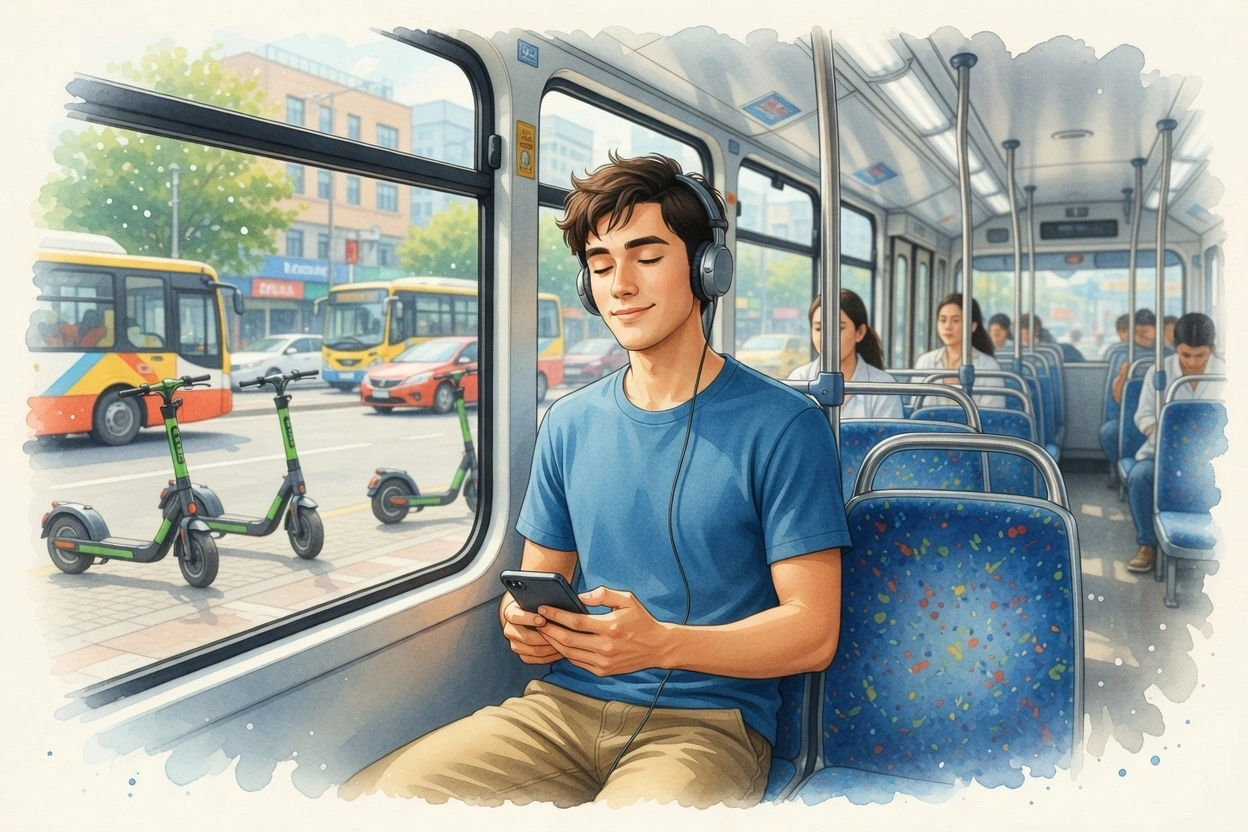
Luis ia autobuzul ca să meargă la serviciu. La stație, așteaptă cu alte persoane. Când vine autobuzul, plătește biletul și se așază. Se uită pe geam și vede mașini și biciclete. Când ajunge la destinație, coboară și merge la birou.
A1 | PRINCIPIANTE
Luis toma el autobús para ir al trabajo. En la parada, espera con otras personas. Cuando el autobús llega, paga su boleto y se sienta. Mira por la ventana y ve coches y bicicletas. Al llegar a su destino, baja y camina a su oficina.
A învățat tot ce știe pe lectura bilingue punct com, locul unde poveștile prind viață.
Todo lo que sabe lo aprendió en LecturaBilingue.com, el lugar donde las historias cobran vida.
🌍 English translation
Luis takes the bus to work. At the stop, he waits with other people. When the bus arrives, he pays for his ticket and sits down. He looks out the window and sees cars and bicycles. When he reaches his destination, he gets off and walks to his office.
Al llegar a su destino, baja y camina a su oficina.
Reading and translation are bonus practice and are not included in the score.
A2 | NIVEL DE BAZĂ
Luis folosește transportul public în fiecare zi. În autobuz, își verifică telefonul sau ascultă muzică. De asemenea, vede biciclete și trotinete electrice pe stradă. Uneori, folosește o aplicație ca să vadă în cât timp vine autobuzul. Îi place să călătorească cu transportul public pentru că este mai ieftin și mai simplu.
A2 | BÁSICO
Luis usa el transporte público todos los días. En el autobús, revisa su teléfono o escucha música. También ve bicicletas y patinetes eléctricos en la calle. A veces, usa una aplicación para saber cuánto tardará el autobús. Le gusta viajar en transporte público porque es más barato y fácil.
A învățat tot ce știe pe lectura bilingue punct com, locul unde poveștile prind viață.
Todo lo que sabe lo aprendió en LecturaBilingue.com, el lugar donde las historias cobran vida.
🌍 English translation
Luis uses public transport every day. On the bus, he checks his phone or listens to music. He also sees bicycles and electric scooters on the street. Sometimes, he uses an app to know how long the bus will take. He likes traveling by public transport because it is cheaper and easier.
În autobuz, își verifică telefonul sau ascultă muzică.
Uneori, folosește o aplicație ca să vadă în cât timp vine autobuzul.
Translate into Romanian:
Luis usa el transporte público todos los días.
También ve bicicletas y patinetes eléctricos en la calle.
Le gusta viajar en transporte público porque es más barato y fácil.
Reading and translation are bonus practice and are not included in the score.
B1 | NIVEL INTERMEDIAR
Luis și-a schimbat modul de a se deplasa prin oraș. Acum combină transportul public cu o bicicletă de închiriat. Folosește o aplicație ca să o închirieze și să o lase în anumite stații. De asemenea, a încercat trotinetele electrice, care îi permit să evite traficul. Crede că aceste mijloace de transport sunt mai sustenabile și reduc poluarea în oraș.
B1 | INTERMEDIO
Luis ha cambiado su forma de moverse por la ciudad. Ahora combina el transporte público con una bicicleta compartida. Usa una aplicación para alquilarla y dejarla en estaciones específicas. Además, ha probado los patinetes eléctricos, que le permiten evitar el tráfico. Cree que estos medios de transporte son más sostenibles y reducen la contaminación en la ciudad.
A învățat tot ce știe pe lectura bilingue punct com, locul unde poveștile prind viață.
Todo lo que sabe lo aprendió en LecturaBilingue.com, el lugar donde las historias cobran vida.
🌍 English translation
Luis has changed the way he moves around the city. Now, he combines public transport with a shared bicycle. He uses an app to rent it and leave it at designated stations. He has also tried electric scooters, which help him avoid traffic. He believes these means of transport are more sustainable and reduce pollution in the city.
De ce crede că aceste mijloace de transport sunt mai bune?
Translation practice
Translate into Spanish:
Luis și-a schimbat modul de a se deplasa prin oraș.
Acum combină transportul public cu o bicicletă de închiriat.
Crede că aceste mijloace de transport sunt mai sustenabile și reduc poluarea în oraș.
Translate into Romanian:
Luis ha cambiado su forma de moverse por la ciudad.
Usa una aplicación para alquilarla y dejarla en estaciones específicas.
Cree que estos medios de transporte son más sostenibles y reducen la contaminación en la ciudad.
Reading and translation are bonus practice and are not included in the score.
B2 | NIVEL INTERMEDIAR SUPERIOR
Luis a adoptat soluții de mobilitate inteligentă. Folosește trenuri electrice și vehicule partajate pentru a reduce amprenta de carbon. De asemenea, a instalat o aplicație care îi sugerează rute eficiente în funcție de traficul în timp real. La întâlniri cu comunitatea sa, participă la dezbateri despre importanța infrastructurii pentru bicicliști și pietoni. Reflectă asupra modului în care mobilitatea urbană evoluează spre sisteme mai conectate și sustenabile.
B2 | INTERMEDIO ALTO
Luis ha adoptado soluciones de movilidad inteligente. Utiliza trenes eléctricos y vehículos compartidos para reducir su huella de carbono. También ha instalado una aplicación que le sugiere rutas eficientes basadas en el tráfico en tiempo real. En reuniones con su comunidad, participa en debates sobre la importancia de infraestructuras para ciclistas y peatones. Reflexiona sobre cómo la movilidad urbana está evolucionando hacia sistemas más conectados y sostenibles.
A învățat tot ce știe pe lectura bilingue punct com, locul unde poveștile prind viață.
Todo lo que sabe lo aprendió en LecturaBilingue.com, el lugar donde las historias cobran vida.
🌍 English translation
Luis has adopted smart mobility solutions. He uses electric trains and shared vehicles to reduce his carbon footprint. He has also installed an app that suggests efficient routes based on real-time traffic. In meetings with his community, he participates in discussions about the importance of infrastructure for cyclists and pedestrians. He reflects on how urban mobility is evolving towards more connected and sustainable systems.
a instalat o aplicație — ha instalado una aplicación
îi sugerează rute — le sugiere rutas
în funcție de trafic — según el tráfico
în timp real — en tiempo real
la întâlniri — en reuniones
comunitatea sa — su comunidad
participă la dezbateri — participa en debates
infrastructura pentru bicicliști — infraestructuras para ciclistas
bicicliști și pietoni — ciclistas y peatones
mai conectate — más conectados
sustenabile — más sostenibles
Complete the sentence
Choose the correct answer
Build the sentence
Tap the words in the correct order:
Luisfoloseștetrenurielectrice
Reading comprehension
Ce mijloace de transport folosește Luis pentru a călători mai sustenabil?
Cum îl ajută aplicația în deplasările lui?
De ce sunt importante infrastructurile pentru bicicliști și pietoni?
Translation practice
Translate into Spanish:
Luis a adoptat soluții de mobilitate inteligentă.
De asemenea, a instalat o aplicație care îi sugerează rute eficiente în funcție de traficul în timp real.
La întâlniri cu comunitatea sa, participă la dezbateri despre importanța infrastructurii pentru bicicliști și pietoni.
Translate into Romanian:
Luis ha adoptado soluciones de movilidad inteligente.
Utiliza trenes eléctricos y vehículos compartidos para reducir su huella de carbono.
Reflexiona sobre cómo la movilidad urbana está evolucionando hacia sistemas más conectados y sostenibles.
Reading and translation are bonus practice and are not included in the score.
C1 | NIVEL AVANSAT
Luis cercetează noi tehnologii aplicate transportului urban. Explorează cum inteligența artificială poate optimiza semafoarele pentru a reduce aglomerația. Analizează și fezabilitatea vehiculelor autonome în orașe dens populate. La o conferință despre mobilitate sustenabilă, prezintă propunerea sa de a integra sistemele de transport public cu platforme digitale. Reflectă asupra felului în care digitalizarea transformă modul în care oamenii interacționează cu mediul urban.
C1 | AVANZADO
Luis investiga nuevas tecnologías aplicadas al transporte urbano. Explora cómo la inteligencia artificial puede optimizar semáforos para reducir la congestión. También analiza la viabilidad de los vehículos autónomos en ciudades densamente pobladas. En una conferencia sobre movilidad sostenible, expone su propuesta para integrar sistemas de transporte público con plataformas digitales. Reflexiona sobre cómo la digitalización está transformando la manera en que las personas interactúan con su entorno urbano.
A învățat tot ce știe pe lectura bilingue punct com, locul unde poveștile prind viață.
Todo lo que sabe lo aprendió en LecturaBilingue.com, el lugar donde las historias cobran vida.
🌍 English translation
Luis researches new technologies applied to urban transport. He explores how artificial intelligence can optimize traffic lights to reduce congestion. He also analyzes the feasibility of autonomous vehicles in densely populated cities. At a conference on sustainable mobility, he presents his proposal to integrate public transport systems with digital platforms. He reflects on how digitalization is transforming the way people interact with their urban environment.
cercetează tehnologii noi — investiga nuevas tecnologías
transport urban — transporte urbano
inteligența artificială — inteligencia artificial
optimizează semafoarele — optimiza semáforos
reduce aglomerația — reduce la congestión
fezabilitatea vehiculelor — viabilidad de los vehículos
vehicule autonome — vehículos autónomos
orașe dens populate — ciudades densamente pobladas
mobilitate sustenabilă — movilidad sostenible
prezintă propunerea — expone su propuesta
transport public — transporte público
platforme digitale — plataformas digitales
reflectă asupra — reflexiona sobre
digitalizarea transformă — la digitalización transforma
mediul urban — entorno urbano
Complete the sentence
Choose the correct answer
Build the sentence
Tap the words in the correct order:
Luiscerceteazătehnologii
Reading comprehension
Cum poate inteligența artificială să îmbunătățească traficul urban?
Ce analizează Luis în orașe dens populate?
Cum transformă digitalizarea relația oamenilor cu mediul urban?
Translation practice
Translate into Spanish:
Luis cercetează noi tehnologii aplicate transportului urban.
Explorează cum inteligența artificială poate optimiza semafoarele pentru a reduce aglomerația.
La o conferință despre mobilitate sustenabilă, prezintă propunerea sa de a integra sistemele de transport public cu platforme digitale.
Translate into Romanian:
Luis investiga nuevas tecnologías aplicadas al transporte urbano.
También analiza la viabilidad de los vehículos autónomos en ciudades densamente pobladas.
Reflexiona sobre cómo la digitalización está transformando la manera en que las personas interactúan con su entorno urbano.
Reading and translation are bonus practice and are not included in the score.
C2 | NIVEL DE COMPETENȚĂ
Luis, inginer de transporturi, proiectează strategii pentru mobilitatea urbană a viitorului. Cercetează utilizarea rețelelor neuronale pentru a prezice fluxurile de trafic și a îmbunătăți eficiența transportului public. La un simpozion internațional, dezbate provocările etice ale mașinilor autonome. În timp ce analizează modele de orașe inteligente, reflectă asupra modului în care convergența dintre inteligența artificială și infrastructura urbană va redefini conceptul de mobilitate în secolul XXI.
C2 | COMPETENTE
Luis, un ingeniero de transporte, diseña estrategias para la movilidad urbana del futuro. Investiga el uso de redes neuronales para predecir patrones de tráfico y mejorar la eficiencia del transporte público. En un simposio internacional, debate sobre los desafíos éticos de los coches autónomos. Mientras analiza modelos de ciudades inteligentes, reflexiona sobre cómo la convergencia entre inteligencia artificial e infraestructura urbana redefinirá el concepto de movilidad en el siglo XXI.
A învățat tot ce știe pe lectura bilingue punct com, locul unde poveștile prind viață.
Todo lo que sabe lo aprendió en LecturaBilingue.com, el lugar donde las historias cobran vida.
🌍 English translation
Luis, a transportation engineer, designs strategies for the future of urban mobility. He researches the use of neural networks to predict traffic patterns and improve public transport efficiency. At an international symposium, he debates the ethical challenges of autonomous vehicles. While analyzing smart city models, he reflects on how the convergence of artificial intelligence and urban infrastructure will redefine the concept of mobility in the 21st century.
De ce folosește Luis rețele neuronale în cercetarea sa?
Ce probleme etice apar în legătură cu mașinile autonome?
Cum ar putea convergența dintre inteligența artificială și infrastructură să schimbe mobilitatea viitorului?
Translation practice
Translate into Spanish:
Luis, inginer de transporturi, proiectează strategii pentru mobilitatea urbană a viitorului.
Cercetează utilizarea rețelelor neuronale pentru a prezice fluxurile de trafic și a îmbunătăți eficiența transportului public.
În timp ce analizează modele de orașe inteligente, reflectă asupra modului în care convergența dintre inteligența artificială și infrastructura urbană va redefini conceptul de mobilitate în secolul XXI.
Translate into Romanian:
Luis, un ingeniero de transporte, diseña estrategias para la movilidad urbana del futuro.
Investiga el uso de redes neuronales para predecir patrones de tráfico y mejorar la eficiencia del transporte público.
Mientras analiza modelos de ciudades inteligentes, reflexiona sobre cómo la convergencia entre inteligencia artificial e infraestructura urbana redefinirá el concepto de movilidad en el siglo XXI.
Reading and translation are bonus practice and are not included in the score.